Search This Blog

Thursday, May 13, 2010

Texas Tech University at Junction


I have arrived at the Texas Tech University Campus in Junction, TX. The scenery is a complete 180 degree turn from that of Lubbock. There is green tree's as far as I can see. Up to now I have seen more wildflowers on the trails than the number we encountered in Lubbock all semester. While, I am here to take a mammalogy class with Dr. Bradley, I am taking advantage of the enormous diversity of both flora and birds. Just yesterday I encountered a Vermilion Flycatcher. Beautiful bird with dark brown and bright red feathers (See Birding Guide below).


The mammalogy class is turning out to be very interesting. We had been setting mice traps since last night. Up to now we have not caught anything, but I hope our luck changes soon. Today, we set traps on a property owned by Tech just west of the campus. On our way to the trapping sight, Dr. Bradley spotted a skunk and shot it. Yes, our class involved the euthanization of the specimens we collect in the field. This is done in order to allow for us to study the specimen at a later time and also provide it for future generations. Our work is important because it provides information regarding the biodiversity of the area and the changes it experiences over time. For example, if we manage to catch a great number of kangaroo rats, then we can compare that to the population numbers of kangaroo rats caught 100 years ago. If we see an increase, then we can conclude that there has been a change in the population due to a specific cause, being the loss of a predator or other changes in the ecological components of the area.

In lab we were introduced to the skulls of coyotes, and we were asked to identify about 38 different bones of the animal's cranium. Just like with birds and wildflowers, we were required to purchase a field guide to skulls. However, much of the identification of the mammal head is based on the number of teeth, diversity within them (incisors, canines, premolars, and molars), and placement of different processes or canals. Later one, as I get better at it I might also post a guide to identifying mammals.

While we are barely at the beginning, I can already feel the stress of the class. This is simply a two week course, so there must be a lot of rapid learning. However, we are required to prepare a collection of 10 different specimens each. This is hard, since I do not know the process of preparing the animal skins. Still, I am up to the challenge. On my free time, I take the opportunity to enjoy the beauty of the campus. Today I took a walk to the South Llano River and took some photographs that I have attached below. In the meantime I shall write as soon as I get the opportunity.

Sunday, May 9, 2010

The End of My First Steps


Milnesand, NM. LPC Festival 2010


At the beginning of the semester, Dr. Susan Tomlinson asked us if we knew the definition of a prairie. None of us had seen one before, and thus we all answered with broad descriptions of what we thought the prairie should be. It was evident that none of us had much interest in the prairies due to the fact that our statements described them as arid, dull, and lifeless stretches of lands. She then asked us what our favorite ecosystem was, and many described luscious and green forests, beaches, and areas far away from the depictions of the prairie we have given earlier. She wanted to know our opinion on what we thought of the prairie, and why did we not prefer it over the greener areas we have described earlier. My idea consisted of the fact that we were not educated on what the prairie is and its importance to our daily lives. However, Dr. Tomlinson made the claim that even individuals educated about it sometimes manage to not care at all for it. This question intrigued me a lot throughout the semester, and it kept popping out in my mind through our fieldtrips, service projects, and outside lectures. Just how can one point out the importance of this ecosystem that is eventually dying off due to human causes. Surely, people of the area donate so much money to save polar bears thousands of miles away, but do not imagine that the habitat that surrounds them is yearning for help. It is a question that I tried to answer, and hopefully have gathered several conclusions now at the end of my journey.


My expectations of this class were far different from what it turned out to be. I had entered the class believing that it would consist of simple lessons in drawing birds and flowers. The idea of keeping a naturalist’s journal scared me a little, since I really did not have a clue of what to put on the journal. I was far more relieved when I was allowed a sense of creativity on the things that I posted in this blog and on my more traditional journal from which I gather the information in the field. Nature is one of my passions and I was willing to undertake this class in order to learn how to preserve those memories. As I might have pointed out, the two major components of this class is the identification of local birds and wildflowers. I must admit that this has been one of the most challenging aspects of the course, since at first one knows nothing about what features in a bird make it recognizable as a species. However, patience and practice soon paid off, and identifying these creatures soon became easier than what many of us first thought.


Example of one of my drawings. These are pigeons that I looked at by the English Building at Texas Tech University.


My LPC Festival Drawings. I drew the territories I observed on the lek, and describe the face offs between the male LPC.

In order to test what I have learned I decided to give myself the assignment to go out to the field and identify a good amount of bird and flower species. So, Saturday after my physics final I grabbed my birding and wildflower field guides, journal, art kit, and binoculars and I decided to head over to Lubbock Lake Landmark and have my very own field day. I had been a little disappointed at the fact that we did not have enough time to experience the flowers of the region, but to my surprise the fields at the Landmark were covered in flowers! The weather was slight cold, low 50s, with a cloudy sky. It was slightly windy at about 20 mph from the south east. There was a game going on at the Lubbock athletic complex, and I was sure that the noise would scare most of the birds away. To my surprise, one of the species I had the opportunity to encounter was not really shy! Also, I found out that I could not only take pictures but see the file names of the photographs on my camera. New tip, as you write down the details of your encounters, you can also write the file name so that you can go back later and see the photograph if you need help identifying! So, I will provide a report below of my findings. I took the pictures of the flowers myself, and those of the birds I got from the internet:


The first flower I found is one that we had seen at Milnesand the weekend of the LPC Festival. It is a compositae called chocolate daisy. This has become one of my favorite flowers. The reason is what helped me identify it from about 20 feet away. As the wind blew in my direction I could smell the richness of chocolate. The slight yellow spikes growing form the disks flower area were noticeable also. As you can see, it is a compositae due to its yellow ray flowers growing form a center with brown/yellow disk flowers. These mostly grew along the trail.


The purple foxglove belongs to the snapdragon family. Its leaves and stems are smooth and thick. They have many tiny hairs growing along that give the plant its gray color. The flowers grow along a stem. Leaves grow in opposite direction from each other. Beautiful small purple flowers that are almost easy to miss.


Next I spotted a beautiful bird. A first I thought it was a meadowlark species, so I simply wrote it down on my bird day list and kept walking. Later, when I kept looking for a strange call, I noticed that it came form this bird. It has a grayish head, black tail, and a bright yellow belly. There is a slight olive, dark gray pattern to the wings. I looked through out the field guide (concentrating in the flycatcher family due to the sharp shape of its beak, its large head, and eyes) and I discovered that this bird was a Western King Bird. My first summer resident bird! This was enough to inspire me to look for more!


I continued to walk down the trail, further away from the cheering crowd, when I encountered another snapdragon flower. This was a beard tongue. It had tiny and rough hairs to the surface of the leaves which are lance shaped. White pale lavender flowers shapped like narrow funnels at the base. It is little less attractive than the purple foxglove but with similar characteristics.


The next flower I encountered close to the beard tongue is one that I could not place in this area. It looked more like a decorative plant one could buy at the local flower shop than the typical wildflower. It is short and bouquet like. It has branched stems with leaves covered with tiny rough hairs. There are 2-3 toothed shapes per ray flowers with yellow disk centers. This was the blackfoot daisy.


Next I saw another bird. These were really far away, but the field marks were evident of its species. They were tiny and sparrow like. Their bodies were completely black with a thick white stripe on their wing. They were in packs, and enjoying the company of the Western King Bird. Every now and then they would all fly together. To my surprise they were gathered near the prairie dogs (who by the way have several colonies in this part of the LLL!). In my opinion, based on their spring range and field marks I decided they must have been Lark Bunting.


Seeing another bird on a day when I doubted the possibilities really let me know how good I had been getting at this over the semester! Way to go! I decided to head back since I had been out for an hour already. However on my way back…


The pink evening primrose was easy to identify since I had met its cousin the evening primrose on class before. Indeed its picture demonstrated the characteristic solitary flowers with light pink veins to petals. The field guide mentioned that for this area of Texas they rarely show the pinkness in the veins. As evident in the picture there is no pink color, however the other white primrose leaf shape and petal number really did not match the one I have found.


The tansy aster, another beautiful organism that seemed very familiar. It grows form a bushy plant with fern like alternating leaves. The flower grows at the head of the tips of its branches. There are 15-25 ray flowers that are violet with a bright yellow disk flower center.


One family of species that I wished to encounter was a legume. At first I confused this flower with its cousin the feather dalea. I had seen it in the past, and both resemble a small shrub. However, this one had soft pink flowers in dense ball-shaped clusters. It possessed small thorns. It is the pink mimosa, who is also known as the cat claw.


The pains zinna. Another small pretty flower and plant. It is low growing with many woody branches. It resembles a small shrub. Leaves are opposite, linear, and narrow. There are 3-4 ray flowers per flower, which are untoothed and broad. The small disk flowers grow in the middle, and are also yellow.


This is a flower that I see every day growing along the trail I take to school. I had wanted to identify it for a while, but the stress of finals prevented me from researching it until today. The leaves of this plant grow on the lower portion of it. It has a large flower that grows tall above the base of the plant. The ray flowers are yellow, shaped into a 3 lobbed cleft. The disk flowers are red and multiple. The flower is called the yellow gaillarda.


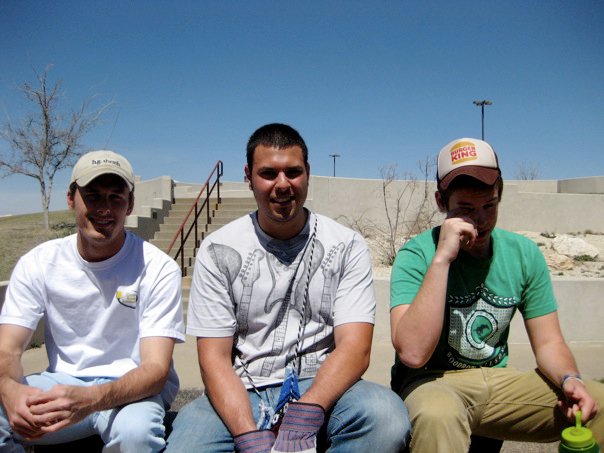
The guys and me, we went tree planting this day at LLL. Photo by Eileen Dee.


The result of my field day… a success! I am please with the finding and more than ever that I would be able to apply my skills in any habitat!
So, what exactly have I learned? Did I answer the question Dr. Tomlinson asked at the beginning of the semester? While I do not consider myself a Llanero, I do have developed an interest for this habitat. It is not until one experiences an intimate relationship with a place that a feeling of responsibility blooms within. I planted native trees in the area, enjoyed the flora and fauna, and even hated it now and then. Still, whether I like how it looks or not, I do care for the prairie. I care that more than 90% of prairies are gone. I care because the prairie is my current home. I care because I have come to develop an interest for the animals and plants that live here. I care because, through my moments alone in this place, I found peace, life, and more important value. The services that the ecology of the prairie provided for me, both in this class and in my stay in Lubbock, have much value. This is what makes me care about this place. I still love the desert, my true home, but the prairie will always be where I encountered nature for the first time. It will always be the first entry in this blog, the first chapter of a life time filled of an appreciation for nature.


What lies ahead? I'm excited to find out!

Wednesday, May 5, 2010

Birding Guide


Birds are interesting creatures to study and look upon, thus here is a small guide to the identification process of birds:
The major tool that one can use to identify birds is the understanding of the body template of each. You all should know how a duck, sparrow, chicken, bird of prey look like. Do not forget to acquire a set of binoculars, since they are of a lot of help. Birds that are usually preyed are shyer, and will fly away when you approach them closely. As with the wildflowers, one must always have a local bird guide to help with the identification of each. Bird guides list the birds in the order of evolutionary existence, so birds are grouped together by their similar families. So if you encounter something that looks like a dove, you can easily find it in the section reserved for doves within your field guide. Another great tool to utilize is a list of local birds in the area in which you are, for example the Lubbock Lake Landmark offers a list of birds that can be identified within its property. It is easier for you to first refer to that list, since it narrows down the probabilities of a bird’s identity. If you are not able to find a birding list, then you can usually acquire this information within your field guide. Mine displays range maps next to each bird’s description. This is a lot of help, since sometimes the range of a bird is the solitary clue that reveals its identity. Birds are not like flowers, in which you have many variations of a species within an area or with specific characteristics (such as number of petals in a flower) to identify. Like I said before, you basically have to first identify what general category the bird falls into, then refer to that section of your field guide in order to utilize the range map, the specific characteristics you see on the bird, and the picture to pin point a birds identity.


Typical Bird Guide Range Map

So, as we did with wildflowers before lets practice with some pictures of birds. You are lucky since watching birds in the field may be hard at first. Sometimes a glimpse is all you get, so unlike with wildflowers, you have to be able to memorize the characteristics that make up that bird.
Here is our first picture:

http://alaska.fws.gov/mbsp/mbm/waterfowl/species/images/Ring-necked-Duck.jpg
In order to proper identify this bird you also need to know where you are when you see it, so here are some clues: You are in McKenzie Park in Lubbock, TX. It is mid-February. The bird is swimming in the lake in front of you. There are others of its kind around it, as well as other different species of birds.
Now that you have this basic information lets try to identify the bird. As you can clearly see, the bird is a duck. There is no doubt about it due to the fact that it has a heavy body, possibly webbed feet, the characteristic bill shape, and it is aquatic. If you look at your field guide, you notice that there are several families of ducks and geese to look at. However, here is a tip that I utilize with these kinds of specific looking ducks: a major distinction factor of this duck is the white ring found on its bill and also the white wings it possesses compared to its black body. These are really good distinction factors to utilize when looking through your bird guide. As you flip through the pages you may encounter several ducks that look alike. These are mostly found within the Pochards, which are diving ducks of the genus Arythya. The Ring necked duck, seems to be very familiar to the one in our picture, and if you look at its description you can see that one of its major characteristics is the “bold white ring near tip of bill.” Also its range is appropriate to the time of year in which it is usually encountered in Lubbock, in the winter. Congratulations you identified your first bird!!!
Here is a harder example:


This is one of my favorite birds. Location: Big Bend National Park, found along the Rio Grande. You see it darting out from a fixed perch to catch an insect. It is a smaller bird.
I do understand that my readers might not all be expert biologists, ornithologists, or birders but I include this difficult bird to teach you that birding is not really that complicated. You definitely know that this bird is not a duck, a hawk, or anything that you commonly see throughout your neighborhood. Look at the list of families and attempt to narrow it down to what you see. If you notice, the birds that might resemble this species are located within the end of your field guide, and not in the beginning where the bigger birds are located. The fact that it is an insect eater is a big clue, since this specialty narrows your look even more. Its pointy beak, its great eyes, and the fact that the size of its head is fairly large tell you that this is probably a specialist in insect catching, and thus my first guess will be that this is some kind of flycatcher. Now look through the flycatcher section. Concentrate on the pictures and range maps first. You will eventually note that the vermillion flycatcher matches the identity through both the description and range in which you have found it.
Here are some practice pictures. Post your answers as comments and see if they are right!


Location: your back yard in Lubbock, TX. It is winter, and the birds are perching on a tree. They are very noisy!


Location: Lubbock, TX. You are near a lake.


Location: Lubbock Lake Landmark. Hint! Look at the pattern in its chest!

Thursday, April 29, 2010

Wildflowers

Our class has recently switched gears from bird watching to wildflower studying and identification. I must admit that I am excited about the change due to a plant’s immovability compared to that of birds. I did realize that identification is a little more difficult since to my eyes the plants all look alike, but I guess that is the whole point of this experience. Thus, in order to help myself, and you of course, I will not only tell you about my experience but attempt to create a guide.
The best way to identify a flower is to know the location that you are in and the flowers that grow within that region. Since I live in Lubbock, it would be smart for me to acquire a field guide or list of local flowers. This is crucial due to the fact that the climatic characteristics of a place greatly affect what kind of vegetation can be found within it. So lets imagine that you find a flower, here is my guide to identifying:


1. Concentrate on the flower first.
a. Look at the size of the flower. Is it small? Large?
b. Look at the number of petals and the pattern in which they grow. Is there a specific number? Is there multiple? Do they grow in a specific pattern? Are the petals bound to each other, or separate?
c. How do the flowers originate in relation to others? Is there only one flower per plant? Multiple? Is the flower a combination of two, an outer ray flower and an inner disk flower as in daisies.
d. Is the flower symmetrical? Irregular in patterns?
e. Where do the petals of the flowers originate?

2. Now look at the leaves and stems.
a. What is the pattern of the leaves?
b. In what numbers do they grow?
c. Are there any spines? Hairs? Substances?
d. What is the shape of the stem?

3. Now look at other characteristics?
a. Does the flower have a specific smell?
b. Is there an irregularity in the plant?
c. When does in bloom?

After answering these questions, you can go ahead grab a field guide or flower list in order to pair up your answers with the descriptions of the different families of flowers that are available in the area. Here is an example of the one in my field guide:

• Cactaceae (cactus family): Succulent stems (pads or barrels) with spines; flowers having numerous petals and stamens.

• Compositae (Daisy, sunflower, or aster family): Small flowers grouped together in compact heads usually displaying outer “ray” and inner “disk” flowers with the entire head often appearing to be the “flower.”

• Cruciferae (mustard family): Flowers typically small, having only four petals, arranged in pairs across from each other; fruit having various shapes but always with two chambers and arranged scattered down the flowering stalk below the flowers. Flowering in early spring.

• Geraniaceae (geranium family): Regular (radially symmetrical) flowers with five non-fused petals, fruit with an elongated, beak like projection with the seed around its base (thus “stork’s-bill common name).

• Labiatae (mint family): Plants with square (quadrangular) stems, opposite leaves, and highly irregular (bilaterally symmetrical) flowers; crushed leaves often have a minty smell.

• Leguminosae (bean or legume family): Plants with compound leaves and fruit (legumes) that are pea pod shaped. Flowers of one subgroup are highly irregular (bilaterally symmetrical) as in sweet peas; another subgroup has mimosa-like flowers with inconspicuous petals and many stamens, forming spherical clusters.

• Malvaceae (mallow family): Regular flowers with five petals and numerous stamens fused by the filaments into a “stamen tree.”

• Onagranceae (evening primrose family): Regular flowers with four sepals, four petals, and, usually eight stamens. The petals arise from a tube that comes off the top of the inferior ovary; fruit four chambered.

• Scrophularianceae (snapdragon family): Broadly irregular flowers with five fused petals (two upper and three lower) and an open throat with four stamens together on the upper surface of the flower throat, which is often hairy or “bearded,” leaves commonly opposite.

• Solanaceae (potato or nightshade family): Regular flowers with five fused petals whose lobes flair at right angles from the floral tube; fruit tomato like with two chambers.

• Verbenaceae (vervain family): Closely related to the Labiatae; square stems and opposite leaves, but with only slightly irregular flowers clustered together in a tight inflorescence (each flower looks similar to a gingerbread man in outline).
Source: Zoe Merriman Kirkpatrick’s Wildflowers of the Western Plains: A Field Guide

Of course these are not the only families of plants that exist, but the most common in the area of Lubbock.

So, now that we have the basic knowledge of flower identification, lets practice with a few flowers that I got do identify in class!


Look at the flowers first and notice that they are not small and not clustered. There are five fused petals that are separated by the dividing lines that arise from the center of the flower. The flower is symmetrical and its sexual organs originate from the middle. There is no presence of other flowers within it or near it. Through this description we can clearly narrow down the list to snapdragon and potato families. At this point you would grab your field guide to the corresponding sections and look for similar pictures and descriptions.
Page 208 of my field guide clearly shows a picture of this flower: Purple Ground Cherry. It turns out it belongs to the Potato/Nightshade family. Fun!
Here are a few more photographs that I took or got from the internet. I decided to leave it to you to identify, in the case that you are unable to go out and do so. Leave me your answers on the comments section if you wish to check for accuracy. Good luck!


Saturday, April 24, 2010

High Plains Lesser Prairie Chicken Festival


Last weekend, our NHH class headed over to the Lesser Prairie Chicken Festival in Milnesand, NM. The trip from Lubbock was short, yet the surroundings changed greatly. New Mexico seemed to maintain much more of the native prairie habitat than Texas, and the change was more evident at the border between the states. Milnesand is a small town with about 5-6 buildings. We were to camp in the back yard of a house, and the celebrations where held at the town’s convention center, a small building located adjunct to the fire fighter department. The people surrounding us were depictions of the serious birders that Dr. Tomlinson had told us about at the beginning of the semester. There were individuals from Florida, California, and even Virginia. I felt a slight sense of intimidation, being that most of them knew much about birds and I was still young in the sport.

The biologists for the United States Fish and Wildlife Service seemed to have a great presence in the area. Being a threatened species, the lesser prairie chicken (LPC) has acquired great priority in this governmental agency. The LPC used to be “found across eastern New Mexico, southeastern Kansas, western Oklahoma, and west Texas,” according to the US Fish and Wildlife Service. Habitat destruction has been a major reason for the decrease in the size of the LPC’s existence. Human population has decreased the amount of prairies available for the bird to live in. This has mainly been due to the use of land for farming, grazing, oil and gas use, and also due to drought. The biologists made it known that a factor contributing LPC numbers are also due to the placement of fences to divide properties. Birds running away from predators can fly up to 60 mph, unable to see the fence at such speeds they may suffer from fatal collisions. Through studies done in the past, scientists for the US Fish and Wildlife determined that LPC deaths due to collisions are high. In order to decrease the collision frequencies, scientists for the US Fish and Wildlife have developed a method of marking the fences in a manner that the LPC can distinguish it and avoid it. Nancy D. Riley is the State Coordinator for the Partners for Fish and Wildlife Program. Along with the residents in the area of Milnesand, she has been in charged of the fence marking program. With the permission of the land owners, volunteers mark the fences with strips of vinyl placed four feet apart along the fence. I got the opportunity to help and this project. Together, my friend Will and I marked at least ¾ of a mile of fence. While it is an easy task to do, the marking provides a lot of benefits to the LPCs that we had met earlier that day.


Markings Will and I placed 3 miles south of Milnesand


Before I talk about the actual LPC mating dance, I would like to point out some specifics regarding the biological and ecological perspectives of such unique creature. According to a birder that accompanied us on the mating dance watching, not many birds behave are involved in mating rituals as the LPC. I asked her because she had mentioned that she was from California, and I was curious to see what attracted her to the festival. The LPC enjoy living in areas with Sand Sagebrush-bluestem and shinnery oak-bluestem vegetation. Their diet consists of mostly insects and seeds. Predators of the LPC include raptors and coyotes, and their eggs are usually consumed by ravens, badgers, skunks, ground squirrels and snakes. They mostly have one brood per year, so preventing nest destruction is crucial for the development of the population.

The males perform their mating rituals within a lek, which is a clear piece of land to where they return to every year. We arrived at the lek at five in the morning, early enough as to not disturb the arrival of the LPC. Our group stayed within the van, and we observed through the windows with our binoculars. Our conversation quickly ended with the noises that the males produced as they arrived to the site. I must admit that to me their dancing is a little robotic. Their calls sounded primate like, with the casual rooster call now and then. They stomped their feet, moved up and down their territories, faced each other now and then, and really put on a show for the mysterious human audience in the vans. I loved the manner in which they would suddenly stop at the sight of a bird flying over head, and then begin their dancing and calls in unison when they realized the passer by was of no danger. Towards the end of our stay in the lek, two females suddenly appeared. As the females picked their male, one could denote the differences between the two. While the males boasted brightly, the females ignored their requests and hid within the grasses. Finally, one of the females picked a male in the outer portion of the lek, and they copulated quickly.


Watching these creatures mate was fascinating, since the product of the union would shine a piece of hope towards the decrease in numbers of the species. The festival was a unique experience, and I find my presence there a great privilege. For those of you interested in attending one day, I must warn you that space is limited. You can find more information at: http://www.wildlife.state.nm.us/recreation/prairie_ckn/Festival.html

Wednesday, April 7, 2010

Las Grutas de Nombre de Dios


This weekend I decided to take a break from school and visit my girlfriend, Gaby, and my family down in Chihuahua, Mexico. On Friday evening, Gaby took me to visit the Grutas de Nombre de Dios (Name of God Caverns), located within a small mountain range east of the city. At first I had my doubts that such natural phenomenon would be located so close to town, but as we approached the entrance to the caverns I discovered why. The caverns are actually a crack within the wall of the mountain that created the chambers through which we were to walk through. The route consists of several rooms and passage ways that total 4364 feet in length, walked by the tour group in about an hour. One descends to a depth of 227 feet under the entrance level, to the point in which one looses any sense of direction, time, or reality. The patterns that one finds within the walls of the caverns are a magnificent artistic show put on by nature over more than 5 million years, forming objects such as food, animals, famous people, and common objects.


This is a scientific blog so I will point out some details to how the caverns were formed. The area where we live today, which includes the area of Chihuahua, was once part of the sea floor. There, organisms such as shellfish and coral died and deposited much of the limestone, or calcium carbonate, that is present in great amounts within the soil of the area. This along with other elements in the soil, such as zinc, iron, and sulfur adorn the walls of the caverns through formations created with the movement of water. Stalactites, which grow on the roof of the cave, and stalagmites, which form at the base, are evidence of the importance of moisture to the natural beauty of the cave. Both occur due to the dripping of water in limestone, which delivers much of the minerals that form it. Their great presence within the caverns gives you a hint to the enormous limestone deposits in the area.
However, much of the stalactites in the caverns appear to have been cut off. The tour guy told us at the beginning of our exploration that before the cave was opened to the public; many individuals would come to the caves and steal the rocks as souvenirs. It is crucial for the rock formations to remain untouched due to the fact that oils in human hands disrupt the passage of the mineralized water. If the water flow is interrupted, then the growth of the rocks deteriorates or the rock will loose its natural coloration. The rocks in the Nombre de Dios Caverns have been forming for over 5 million years; still, the contaminants in the air from the nearby city and the dry air caused by droughts have slowed down the delicate process.


The state of Chihuahua has recently taken over the maintenance of the caves in order to protect this underground tourist attraction. I seriously believe that the best way to defend nature from human mismanagement is to educate individuals regarding its importance and in this case rarity. This is exactly what the state has done. They made the caverns more accessible to the public by installing pathways along the natural floor of the caverns, and provide the individual with an education on how to enjoy them without harming their existence. This really made me think about what is being done at Lubbock Lake Landmark (LLL). The prairie within the area is being recovered while the staff provides the Lubbock community with the education needed to prevent future destructive management. However is there a cost to what LLL is doing? At the Nombre de Dios caverns, the incoming of tourists through the caves has dried up some of the moisture, adding to the decrease in growth rate of stalactites and stalagmites.

The caverns are opened Tuesdays through Sundays from 9 am to 4 pm. For more information you can contact the office at 01(604) 432 0518 or visit www.chihuahua.gob.mx/turismoweb and www.ah-chihuahua.com for more general information. The city of Chihuahua contains many museums, historical sites, and recreational attractions that are surely enough fill in a weekend.

Tuesday, April 6, 2010

Tree Planting

I have talked a lot on previous posts about the consequences that human activities have had on the prairie. However, this past Wednesday I got the opportunity to do something about it. Our class, along with several employees of the Lubbock Lake Landmark took up the task to plant native trees throughout the property. The staff had selected several sites for the native trees previously with the help of the archeological department to ensure that no artifacts were uncovered during the transplantations. We had Soapberries and Hackberries to plant. While I looked forward to the planting process all week, I must admit that I did not expect to plant such mature trees as we did that day. With more than 20 trees to plant, I started to regret volunteering to dig the new homes for the woody specimens. Still, I was driven by the inspiration that someday I would have to opportunity to come back and see the full grown trees that we have planted. While we did not finish planting all the trees, I feel as if the exhaustion my body felt will one day turn into a sense of pride. I have not only added beauty to the surrounding, but also an opportunity to recover from an ecological disaster. Go plan a tree!