Search This Blog

Monday, September 20, 2010

NOMA


We were doing a personal culture activity today in my LCG class and I came to realize something really interesting that was happening within my students. There was a clear split between individuals who believe in creation and those in evolution. It seems as though individuals who are religious seem to be skeptic regarding science because of this division. I consider myself somewhat religious. I believe in God, and I am currently on the process of becoming a catholic. However, I do believe on evolution. How can this be possible? Well my friends… I rely on the Theory of Non-Overlapping Magisteria (NOMA). Created by Stephen Jay Gould, it advocates the idea that neither religion nor science are more important than each other. In other words… there is a strict separation between both ideologies. Each magisteria holds its own questions, and these are the questions that they are capable of answering. For example: medical science answers questions regarding illness, whereas the bible answers questions regarding sin. “The bible is not a biology book,” is one of the quotes that I remember my Biology professor, Dr. Michael Dini, say as he explained the theory to our class. “Where do we come from?” is a measurable question which can be answered by science. ‘Why are we here?” is clearly defined in the bible and can not be measured by the realm of science. Thus, these questions are best answered by each realm that has the resources to do so. One is free to study nature in any way. However, because of my scientific backgroud this blog is designed to do so through a scientist's perspective. Everybody is welcomed to read it. I am just asking for tolerance and understanding. Maybe you do not believe in evolution, but that does not mean that science is out of your reach.

Tuesday, September 7, 2010

What is place?

I am taking a class with Dr. T agian! Here is a post of my latest assignment.

El Paso, TX is a location that derives a lot of sentiment within me. I often try to associate these feelings with its definition of a place; however, is a place something that creates sentiment. My current home, Lubbock, TX generates distinct emotions that are different from those of El Paso. If so, do different geographical locations deserve equal or different categorizations? I am asked to define a place, yet in order to do so I will have apply this definition in an non-subjective manner. In my perspective, a place is a location capable of sustaining a unique aspect of life. Life can be defined as nature or human activity. El Paso is home to nearly 600,000 individuals along with numerous desert species of plants and animals. It is an international border town that is shaped by three distinct cultures: Mexican, Texan, and Native American. The customs of these three sources influence the society of the city by affecting the way the people interact with their environment and with each other. Unlike the rest of Texas, El Paso retains a more liberal perspective on environmental and moral issues. The Franklin Mountains, surrounded by the city, retain the original desert ecosystem of the urban location.
All the physical and cultural characteristics of a site seem to be the contributing aspects that define it as a place. We can argue that a place is somewhere you hear about, a locality you can visit, or even an area that basically exists. Yet, in order for one to know it as a place, there has to be certain characteristics that get impregnated within the human mind. How can point-A be a different place than point-B if they are exactly alike? It is when there is a difference between the two that one can distinguish them apart. One can utilize human or even natural based characteristics of point-A, El Paso, versus point-B, Lubbock, to recognize that they are different and attain the ability to relate to their literature, art, traditions, and importance in the natural and human directed perspectives of what the world is.

Friday, June 25, 2010

Natural Science Research Sampling


It has been a while since I have posted anything in this blog, but I must admit that school has kept me very busy. After Junction, I went back to Chihuahua. I had a good time, even though it lasted too little. I have been taking microbiology and organic evolution at Tech this summer and have been able to acquire some knowledge over what was done at Junction in my mammalogy class. Those samples that we gathered are used in research on disease, evolutionary processes, and even animal characteristics themselves. How can we study disease from animals gathered in the field? This is a very interesting process that covers many aspects of biology. Epidemiology, ecology, evolutionary sciences, and even biotechnology are tools that us scientists can utilize in order to acquire data that we can use to treat, prevent, and even understand pathogenic disorders. By acquiring the tissues, one can identify organisms that serve as carriers of disease, which can be spread to humans. Below I will explain the process to acquiring these samples, preserving the skins and skulls of the animal. As a model I will be using a Peromyscus pectoralis. This is a common deer mouse found throughout much of the American continent.
As I had said in earlier entries, the rodents are collected in the field via the use of live traps (in our case Sherman Traps). Once collected, the mouse is brought to the lab where it is paralyzed. We collect blood form the eye socket through the use of capillaries while the mouse is still alive. After the animal is sacrificed, it is usually frozen and set a aside until one is ready to prepare the specimen.

When the specimen is ready to be prepared, one acquires measurements of the animals total body length, tail length, fore foot length, and ear length. If you are working with a bat, you will also measure its tragus (a small structure in front of the ear). Also, one needs to acquire the weight of the animal. Once these measurements are taken and annotated, you are ready to begin the skin removal.


You begin to remove the skin by creating a delicate incision within the abdomen, being careful not to puncture the abdominal cavity. You begin by removing the legs first to the feet, where you would cut the tibula and fibula at the base where it meets the foot. Then you remove the tail, being careful to first cut off all muscle, urethra, and large intestine. You pull the tail by grabbing the buttocks with one hand and the skin at the base of the tail with the other. You continue to remove the skin throughout the body which is easy until you come to the arms. The arms are easily removed if you pretend that you are taking off a “sweater” then cutting off at the base of the hand where it meets the ulna and radius. The head is a little tricky to skin since there is a lot of connective tissue, but if you cut it with scissors at base of skull you should be able to remove your skin without damaging it.


Once you have skinned your mouse, you want to rub the skin in corn meal. This will absorb most of the fat and moisture that can damage the look of your skin. You continue to remove the organs from the carcass. The heart, kidney, lungs, liver, spleen, and a piece of muscle are collected in order to perform DNA studies or any other that are needed. The samples are stored in liquid nitrogen in order to preserve the delicate RNA which begins to degrade immediately after the animal dies. When the carcass is empty, you can wrap it in string and dry it. It will later be exposed to flesh eating beetles that will clean it of all flesh.


The skin is then filled with cotton and wires and sown shut. When you prepare the skin, you want to make it look real. The specimen is likely to last up to 200 years, and you want to make it look its best for future scientist to study.


An evolutionary scientist can utilize your sample in order to acquire clues when building phylogenic trees. These are hypothetical depictions of the evolutionary processes. These trees have a lot of purposes since they can be utilized in many ways to answer many questions. The great thing about this process of specimen collection is that it allows one to explore both biology and natural history. One acquires a small representation of the species available in an area at a certain time. If you are interested in this, you can visit the Texas Tech Museum in Lubbock, TX. They currently present an exhibit regarding this process. I myself have 10 specimens stored within the museum that I was allowed to prepare in Junction. Although one is not allowed to freely experience the mammal and ornithology collections, the museum allows the public to view a few specimens within the museums exhibits. Above all, knowing that an individual will be utilizing your work for research in nearly 200 years makes you feel that the hard work was worth it.

Tuesday, May 18, 2010

Mammalogy Class #2

For my classmates in Mammalogy at Junction, here are the materials for the second lab test. Rami made some practice quiz slides, that only contain the pictures, that you can also utilize. I encourage you to quiz yourself on the different taxonomic levels of each picture and any other characteristics that Cody might have mentioned in class. (such as type of teeth, fur, ect.) Enjoy!

Mammalogy Lab 7 Power Point:
http://www.slideshare.net/obhernan/mammalogy-lab-7
Mammalogy Lab 7 practice quiz:
http://www.slideshare.net/obhernan/quiz-lab-7
Mammalogy Lab 8 Power Point:
http://www.slideshare.net/obhernan/mammalogy-lab-8
Mammalogy Lab 9 Power Point:
http://www.slideshare.net/obhernan/mammalogy-lab-9
Mammalogy Lab 10 Power Point:
http://www.slideshare.net/obhernan/mammalogy-lab-10

Friday, May 14, 2010

Mammalogy Class

For the members of my Mammalogy Class in Junction. Here are the pictures of the Coyote Skulls we need to ID.


Here is the slide for the mammals in Lab 3: http://www.slideshare.net/obhernan/mammalogy-lab-3

Here is the slide for the mammals in Lab 4:
http://www.slideshare.net/obhernan/mammalogy-lab-4

Here is the slide for the mammals in lab 5:
http://www.slideshare.net/obhernan/mammalogy-lab-5

Here is the slide for the mammals in Lab 6:
http://www.slideshare.net/obhernan/mammalogy-lab-6

Thursday, May 13, 2010

Texas Tech University at Junction


I have arrived at the Texas Tech University Campus in Junction, TX. The scenery is a complete 180 degree turn from that of Lubbock. There is green tree's as far as I can see. Up to now I have seen more wildflowers on the trails than the number we encountered in Lubbock all semester. While, I am here to take a mammalogy class with Dr. Bradley, I am taking advantage of the enormous diversity of both flora and birds. Just yesterday I encountered a Vermilion Flycatcher. Beautiful bird with dark brown and bright red feathers (See Birding Guide below).


The mammalogy class is turning out to be very interesting. We had been setting mice traps since last night. Up to now we have not caught anything, but I hope our luck changes soon. Today, we set traps on a property owned by Tech just west of the campus. On our way to the trapping sight, Dr. Bradley spotted a skunk and shot it. Yes, our class involved the euthanization of the specimens we collect in the field. This is done in order to allow for us to study the specimen at a later time and also provide it for future generations. Our work is important because it provides information regarding the biodiversity of the area and the changes it experiences over time. For example, if we manage to catch a great number of kangaroo rats, then we can compare that to the population numbers of kangaroo rats caught 100 years ago. If we see an increase, then we can conclude that there has been a change in the population due to a specific cause, being the loss of a predator or other changes in the ecological components of the area.

In lab we were introduced to the skulls of coyotes, and we were asked to identify about 38 different bones of the animal's cranium. Just like with birds and wildflowers, we were required to purchase a field guide to skulls. However, much of the identification of the mammal head is based on the number of teeth, diversity within them (incisors, canines, premolars, and molars), and placement of different processes or canals. Later one, as I get better at it I might also post a guide to identifying mammals.

While we are barely at the beginning, I can already feel the stress of the class. This is simply a two week course, so there must be a lot of rapid learning. However, we are required to prepare a collection of 10 different specimens each. This is hard, since I do not know the process of preparing the animal skins. Still, I am up to the challenge. On my free time, I take the opportunity to enjoy the beauty of the campus. Today I took a walk to the South Llano River and took some photographs that I have attached below. In the meantime I shall write as soon as I get the opportunity.

Sunday, May 9, 2010

The End of My First Steps


Milnesand, NM. LPC Festival 2010


At the beginning of the semester, Dr. Susan Tomlinson asked us if we knew the definition of a prairie. None of us had seen one before, and thus we all answered with broad descriptions of what we thought the prairie should be. It was evident that none of us had much interest in the prairies due to the fact that our statements described them as arid, dull, and lifeless stretches of lands. She then asked us what our favorite ecosystem was, and many described luscious and green forests, beaches, and areas far away from the depictions of the prairie we have given earlier. She wanted to know our opinion on what we thought of the prairie, and why did we not prefer it over the greener areas we have described earlier. My idea consisted of the fact that we were not educated on what the prairie is and its importance to our daily lives. However, Dr. Tomlinson made the claim that even individuals educated about it sometimes manage to not care at all for it. This question intrigued me a lot throughout the semester, and it kept popping out in my mind through our fieldtrips, service projects, and outside lectures. Just how can one point out the importance of this ecosystem that is eventually dying off due to human causes. Surely, people of the area donate so much money to save polar bears thousands of miles away, but do not imagine that the habitat that surrounds them is yearning for help. It is a question that I tried to answer, and hopefully have gathered several conclusions now at the end of my journey.


My expectations of this class were far different from what it turned out to be. I had entered the class believing that it would consist of simple lessons in drawing birds and flowers. The idea of keeping a naturalist’s journal scared me a little, since I really did not have a clue of what to put on the journal. I was far more relieved when I was allowed a sense of creativity on the things that I posted in this blog and on my more traditional journal from which I gather the information in the field. Nature is one of my passions and I was willing to undertake this class in order to learn how to preserve those memories. As I might have pointed out, the two major components of this class is the identification of local birds and wildflowers. I must admit that this has been one of the most challenging aspects of the course, since at first one knows nothing about what features in a bird make it recognizable as a species. However, patience and practice soon paid off, and identifying these creatures soon became easier than what many of us first thought.


Example of one of my drawings. These are pigeons that I looked at by the English Building at Texas Tech University.


My LPC Festival Drawings. I drew the territories I observed on the lek, and describe the face offs between the male LPC.

In order to test what I have learned I decided to give myself the assignment to go out to the field and identify a good amount of bird and flower species. So, Saturday after my physics final I grabbed my birding and wildflower field guides, journal, art kit, and binoculars and I decided to head over to Lubbock Lake Landmark and have my very own field day. I had been a little disappointed at the fact that we did not have enough time to experience the flowers of the region, but to my surprise the fields at the Landmark were covered in flowers! The weather was slight cold, low 50s, with a cloudy sky. It was slightly windy at about 20 mph from the south east. There was a game going on at the Lubbock athletic complex, and I was sure that the noise would scare most of the birds away. To my surprise, one of the species I had the opportunity to encounter was not really shy! Also, I found out that I could not only take pictures but see the file names of the photographs on my camera. New tip, as you write down the details of your encounters, you can also write the file name so that you can go back later and see the photograph if you need help identifying! So, I will provide a report below of my findings. I took the pictures of the flowers myself, and those of the birds I got from the internet:


The first flower I found is one that we had seen at Milnesand the weekend of the LPC Festival. It is a compositae called chocolate daisy. This has become one of my favorite flowers. The reason is what helped me identify it from about 20 feet away. As the wind blew in my direction I could smell the richness of chocolate. The slight yellow spikes growing form the disks flower area were noticeable also. As you can see, it is a compositae due to its yellow ray flowers growing form a center with brown/yellow disk flowers. These mostly grew along the trail.


The purple foxglove belongs to the snapdragon family. Its leaves and stems are smooth and thick. They have many tiny hairs growing along that give the plant its gray color. The flowers grow along a stem. Leaves grow in opposite direction from each other. Beautiful small purple flowers that are almost easy to miss.


Next I spotted a beautiful bird. A first I thought it was a meadowlark species, so I simply wrote it down on my bird day list and kept walking. Later, when I kept looking for a strange call, I noticed that it came form this bird. It has a grayish head, black tail, and a bright yellow belly. There is a slight olive, dark gray pattern to the wings. I looked through out the field guide (concentrating in the flycatcher family due to the sharp shape of its beak, its large head, and eyes) and I discovered that this bird was a Western King Bird. My first summer resident bird! This was enough to inspire me to look for more!


I continued to walk down the trail, further away from the cheering crowd, when I encountered another snapdragon flower. This was a beard tongue. It had tiny and rough hairs to the surface of the leaves which are lance shaped. White pale lavender flowers shapped like narrow funnels at the base. It is little less attractive than the purple foxglove but with similar characteristics.


The next flower I encountered close to the beard tongue is one that I could not place in this area. It looked more like a decorative plant one could buy at the local flower shop than the typical wildflower. It is short and bouquet like. It has branched stems with leaves covered with tiny rough hairs. There are 2-3 toothed shapes per ray flowers with yellow disk centers. This was the blackfoot daisy.


Next I saw another bird. These were really far away, but the field marks were evident of its species. They were tiny and sparrow like. Their bodies were completely black with a thick white stripe on their wing. They were in packs, and enjoying the company of the Western King Bird. Every now and then they would all fly together. To my surprise they were gathered near the prairie dogs (who by the way have several colonies in this part of the LLL!). In my opinion, based on their spring range and field marks I decided they must have been Lark Bunting.


Seeing another bird on a day when I doubted the possibilities really let me know how good I had been getting at this over the semester! Way to go! I decided to head back since I had been out for an hour already. However on my way back…


The pink evening primrose was easy to identify since I had met its cousin the evening primrose on class before. Indeed its picture demonstrated the characteristic solitary flowers with light pink veins to petals. The field guide mentioned that for this area of Texas they rarely show the pinkness in the veins. As evident in the picture there is no pink color, however the other white primrose leaf shape and petal number really did not match the one I have found.


The tansy aster, another beautiful organism that seemed very familiar. It grows form a bushy plant with fern like alternating leaves. The flower grows at the head of the tips of its branches. There are 15-25 ray flowers that are violet with a bright yellow disk flower center.


One family of species that I wished to encounter was a legume. At first I confused this flower with its cousin the feather dalea. I had seen it in the past, and both resemble a small shrub. However, this one had soft pink flowers in dense ball-shaped clusters. It possessed small thorns. It is the pink mimosa, who is also known as the cat claw.


The pains zinna. Another small pretty flower and plant. It is low growing with many woody branches. It resembles a small shrub. Leaves are opposite, linear, and narrow. There are 3-4 ray flowers per flower, which are untoothed and broad. The small disk flowers grow in the middle, and are also yellow.


This is a flower that I see every day growing along the trail I take to school. I had wanted to identify it for a while, but the stress of finals prevented me from researching it until today. The leaves of this plant grow on the lower portion of it. It has a large flower that grows tall above the base of the plant. The ray flowers are yellow, shaped into a 3 lobbed cleft. The disk flowers are red and multiple. The flower is called the yellow gaillarda.


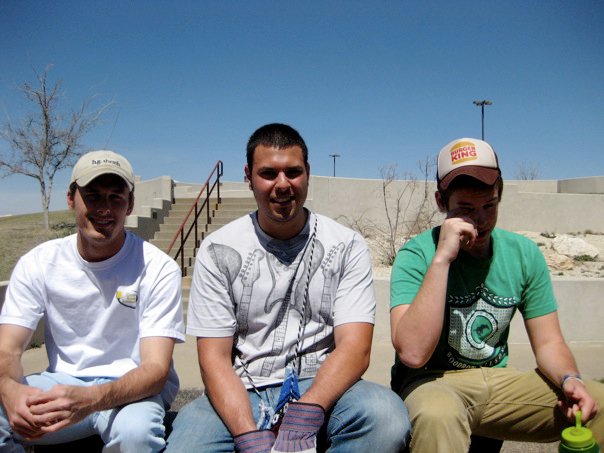
The guys and me, we went tree planting this day at LLL. Photo by Eileen Dee.


The result of my field day… a success! I am please with the finding and more than ever that I would be able to apply my skills in any habitat!
So, what exactly have I learned? Did I answer the question Dr. Tomlinson asked at the beginning of the semester? While I do not consider myself a Llanero, I do have developed an interest for this habitat. It is not until one experiences an intimate relationship with a place that a feeling of responsibility blooms within. I planted native trees in the area, enjoyed the flora and fauna, and even hated it now and then. Still, whether I like how it looks or not, I do care for the prairie. I care that more than 90% of prairies are gone. I care because the prairie is my current home. I care because I have come to develop an interest for the animals and plants that live here. I care because, through my moments alone in this place, I found peace, life, and more important value. The services that the ecology of the prairie provided for me, both in this class and in my stay in Lubbock, have much value. This is what makes me care about this place. I still love the desert, my true home, but the prairie will always be where I encountered nature for the first time. It will always be the first entry in this blog, the first chapter of a life time filled of an appreciation for nature.


What lies ahead? I'm excited to find out!